
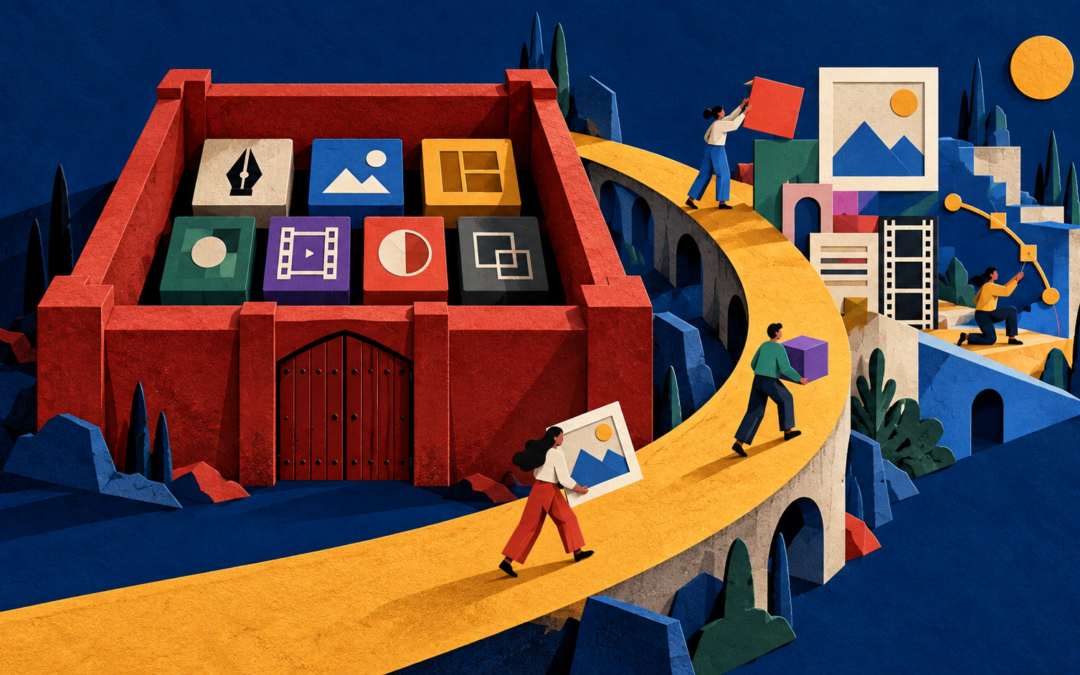
Someone just used AI to rebuild Adobe’s Creative Cloud in about a week, gave it away for free, and 42,000 people starred it on GitHub before Adobe finished its coffee. That’s not a rumor. It’s a download link.
I’ve spent my career inside Photoshop, Illustrator and InDesign. So when a friend’s LinkedIn post showed a layout built in something called DesignCraft, I did what any self-respecting designer would do at 1 a.m.: I went down the rabbit hole. Here’s what I found, what I think it means, and why it matters for your brand even if you’ve never opened a design app in your life.
Seven apps, one developer, one AI
The project is called ArtCraft, built by software engineer Brandon Thomas with Anthropic’s Claude Opus 5.5 doing most of the typing. Each app maps to an Adobe flagship:
|
ArtCraft app |
Stands in for |
|
PhotoCraft |
Photoshop |
|
VectorCraft |
Illustrator |
|
DesignCraft |
InDesign |
|
FilmCraft |
Premiere Pro |
|
EffectCraft |
After Effects |
|
LightCraft |
Lightroom |
|
PrintCraft |
Acrobat Pro |
They’re written in Rust, a modern programming language prized for speed and memory safety, and they ship as native apps for Mac, Windows and, yes, Linux. Phoronix notes there are even FreeBSD builds. The code is open source under MIT and Apache licenses, which means anyone can use, modify or fork it.
Tech term of the day: clean-room reimplementation. It’s a way to copy what software does without copying its code. Classically, one team studies the original and writes a spec; a second team that has never seen the original builds from that spec alone. It’s how Compaq legally cloned the IBM PC BIOS in the ’80s. ArtCraft says its apps were built only from public specs (like Adobe’s published PSD format) and observed behavior.
Fair warning: this is alpha software. Bugs, crashes and missing features are part of the deal right now. But it opens, it works, and it’s improving weekly.
Why this was inevitable
Adobe didn’t lose a feature war here. It lost a goodwill war. Three forces collided at once.
1. Subscription fatigue hit a breaking point. Thomas says he built ArtCraft after getting hit with Adobe’s cancellation fee one too many times. He’s not alone: Adobe agreed this year to a $150 million settlement over a 2024 federal lawsuit alleging it trapped customers in hard-to-cancel plans. When your pricing becomes a court case, your customers start shopping for exits.
2. Whole communities were ignored. Adobe has never officially supported Linux, despite years of requests. That left a lot of creatives stuck on operating systems they didn’t want, paying for software they used a few times a year. ArtCraft served them on day one.
3. AI collapsed the cost of building software. This is the real headline. Vibe coding (describing what you want and letting an AI model write the code) let one engineer produce in days what used to take a team months or years. Thomas has said publicly he believes AI will eventually make 1:1 open-source alternatives to proprietary software routine.
Put those together and you get the question that should keep every software company up at night: if you frustrate your users enough, will they simply build around you? As of this month, the answer is yes.
The honest take: exciting, not ready
I’m rooting for ArtCraft. I’m also not moving a single client project onto it yet. Here’s why.
• The legal ground is shaky. Clean-room rebuilding of functionality is generally accepted. But a classic clean room uses two separate teams; here it’s one developer and an AI trained on mountains of public code, and critics have asked what that model absorbed. Reporting via Ars Technica also flags trade dress: legal protection for a product’s distinctive look and feel. Copy an interface too closely and you can lose even if every line of code is original. Adobe also holds thousands of software patents.
• Pro work needs boring reliability. Color accuracy, print-ready output, plugin ecosystems and file fidelity are where design tools earn their keep. Early users report crashes on complex layered PSDs. A layout that shifts by two points on export is not a quirk when it’s a 5,000-piece print run.
• Speed cuts both ways. Updates land in days because AI writes much of the code. That’s thrilling for features and nerve-racking for stability and security. Install from the official source only, and keep it away from client files for now.
• Open source needs fuel. A January 2026 preprint, Vibe Coding Kills Open Source, argues AI-generated replacements can erode the communities that maintain the tools we all depend on. ArtCraft plans to fund itself by selling optional access to its AI image model. Whether that sustains seven complex apps is an open question.
My verdict: watch it, play with it, contribute if you can. Don’t bet a deadline on it in 2026.
What this means for your business
You probably don’t run Photoshop. But the lesson of ArtCraft applies to every brand with customers: the moat isn’t your product anymore. It’s how people feel about you.
When anyone with an AI model can rebuild your features in a week, features stop being the reason people stay. Experience is. Trust is. The story you tell and whether you live up to it. Adobe has world-class software and still created a crowd eager to leave, because the relationship soured long before the code did.
For small businesses, that’s genuinely good news. Three takeaways:
1. Make leaving easy and staying obvious. Transparent pricing, no dark patterns, no cancellation traps. Customers forgive a lot; they don’t forgive feeling caught.
2. Listen to the long threads. Adobe’s Linux users asked for years. Somebody else answered. Whatever your customers keep asking for, assume a competitor (or an AI-armed customer) is listening too.
3. Own your story, not just your stack. Tools will keep getting cheaper and more interchangeable. A brand people believe in won’t.
That’s exactly how we work at 11:11 Designs. We’re tool-agnostic on purpose: we pick what’s right for your brand today and handle the headaches when the landscape shifts, so you can stay focused on your customers. Storytellers by design, whatever software the future runs on.
Curious whether your brand is building loyalty or just features? Let’s talk.