
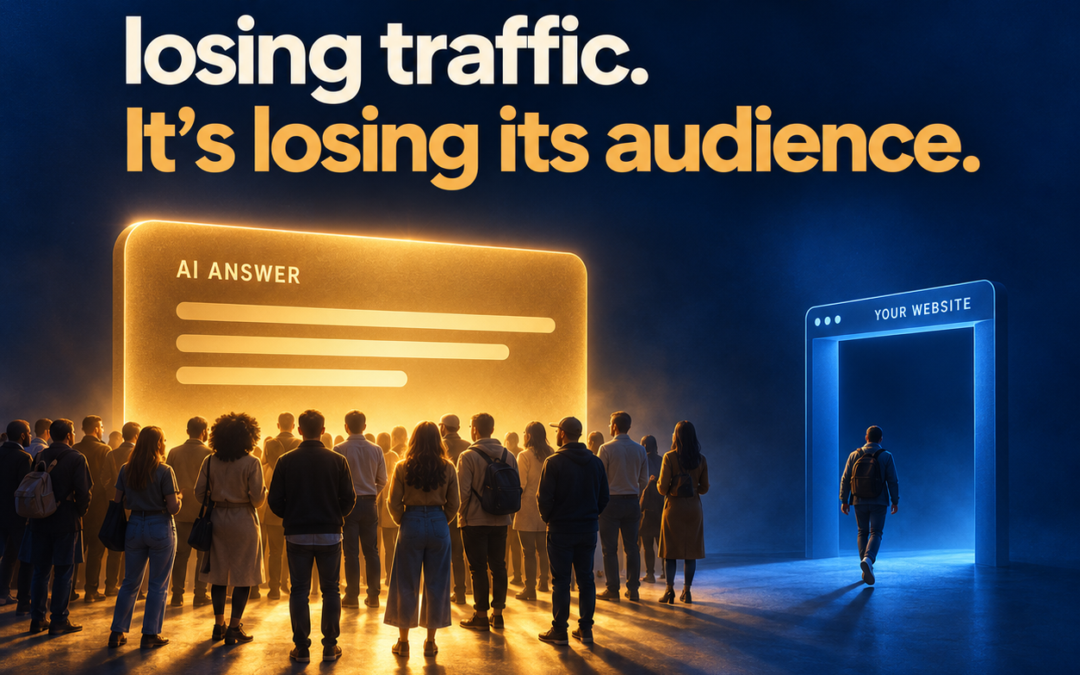
Search stopped sending people. It started sending answers. Here is what that means for your business, and what to do about it.
A client emailed us in the spring. Traffic down roughly a third year over year. Rankings unchanged. No penalty, no outage, no redesign, nothing broken in Search Console. Their site was doing exactly what it had always done. The internet had simply stopped rewarding it.
This is the most common conversation we are having in 2026, and it is worth naming plainly: your website is not failing. The delivery system changed. Google used to be a switchboard that connected a question to your page. It is now an answering machine that reads your page and keeps the caller.
What is zero-click search, and why does it matter now?
A zero-click search is a query that ends on the results page. The user gets what they came for from an AI Overview, a featured snippet, or a knowledge panel, and never visits a website.
This is not new. What changed is the slope. SparkToro’s clickstream analysis of U.S. Google searches from January through April 2026 found the share of searches producing at least one click fell by 9.51 percentage points between 2024 and 2026, a relative decline of nearly 23 percent. BrightEdge put AI Overview coverage at roughly 48 percent of tracked queries as of February 2026, up about 58 percent year over year.
Half of search now arrives with the answer pre-written. That is not a trend. That is a new floor.
How much traffic are AI Overviews actually taking?
Enough to notice on a P&L.
Ahrefs compared Google Search Console click-through data from before AI Overviews launched against December 2025. For informational keywords where an AI Overview appears, average click-through rate at position one dropped from about 7.6 percent to 1.6 percent. Their measured reduction in clicks to the top result went from 34.5 percent in April 2025 to 58 percent eight months later. The curve is steepening, not flattening.
Publishers have felt it hardest. Press Gazette reported U.S. publisher referral traffic from Google down 38 percent year over year. Pew Research, analyzing nearly 69,000 real searches in July 2025, found users clicked a traditional result 8 percent of the time when an AI Overview was present, versus 15 percent when it was not.
Read that last one twice. Ranking first is no longer the same thing as being found.
Is the traffic that remains worth more?
Yes, and this is the part almost nobody tells small businesses.
The visitors who do click through from AI-generated answers arrive further along. Semrush found AI-referred visitors converted at roughly 4.4 times the rate of traditional organic visitors. They have already been briefed. They are not researching anymore. They are deciding.
So the honest picture is not “traffic is dying.” It is that the top of your funnel got absorbed by a machine, and what reaches you is a shorter, hotter list of people who already believe you might be the answer. Fewer visits. Better visits. Different math.
Bain’s 2025 B2B research adds the uncomfortable coda: 85 percent of buyers purchase from the vendor shortlist they formed before they ever searched. Visibility that never produces a click still produces revenue. You just cannot see it in a traffic graph.
If ranking is not the goal, what is?
Citation.
The unit of visibility moved from position to source attribution. The question is no longer “where do we rank for this phrase,” it is “when a language model answers this question, does it name us.”
Those are not the same skill. A cross-methodology analysis published in March 2026 by ALM Corp found the share of AI Overview citations coming from pages that also rank in the traditional top ten dropped from 76 percent to 38 percent. Being on page one is now roughly a coin flip for being quoted. The models are choosing sources on different criteria than the ranking algorithm uses.
What actually makes a website citable?
Here is what we build for, in order of how much it moves the needle.
Answer first, elaborate second. Language models extract passages. If your answer arrives in paragraph six after a warm-up about how we live in a fast-paced digital world, it does not get extracted. State the answer in the first two sentences under the heading, then earn the rest.
Headings shaped like questions. People ask questions. Models match questions. A section titled “How much does a custom website cost in San Francisco” is retrievable. A section titled “Investment” is not.
Structured data that describes what you are. Organization, LocalBusiness, Article with a real named author, FAQPage where it genuinely applies. Schema is how a machine confirms that the entity on the page is the entity in its index. Skip it and you are asking to be inferred rather than known.
Entity consistency. Same business name, same address, same phone, same claims, everywhere. Models resolve entities by corroboration across sources. Contradictions do not get resolved, they get dropped.
Specifics over adjectives. Original numbers, named people, dates, prices, methods, real outcomes. “Award-winning” is unquotable. A sentence like “consultation requests went from four a month to nineteen after the rebuild” is one a model can use, because it carries information.
Semantic HTML that is actually semantic. Real headings, not styled divs. Text as text, not text baked into an image. Content in the initial HTML, not assembled by JavaScript after the fact, served from hosting that answers a crawler quickly. Every layer of cleverness between a crawler and your sentences is a tax on being understood. We have argued before that design is infrastructure; this is the same argument with a new reader.
Third-party corroboration. Citations follow reputation. Being mentioned by someone else remains the single hardest and most valuable signal, and no on-page tactic substitutes for it.
What about llms.txt?
You will get pitched this. Here is the unvarnished version.
llms.txt is a proposed file at your site root that hands AI systems a curated map of your best content. The idea is sound. The adoption is not there. Google’s Gary Illyes confirmed in 2025 that Google does not support it and has no plans to, and John Mueller publicly likened it to the long-discredited keywords meta tag. Server log studies across hundreds of millions of AI bot visits show the major answer engines request the file at rates rounding to zero. SE Ranking’s crawl of 300,000 domains found about 10 percent adoption, and among the most-cited domains in AI answers, almost none had one.
Ship it if it costs you twenty minutes and you like experiments. Do not let anyone sell it to you as an AI search strategy. It is not one yet.
What should you be measuring instead?
Traffic alone is now a lagging and misleading indicator. Watch these:
- Branded search volume. The clearest proxy for whether AI answers are seeding your name.
- Direct traffic. People who heard about you somewhere they did not click.
- AI referral sessions. Segment chatgpt.com, perplexity.ai, gemini.google.com and similar referrers in GA4. Small numbers, high intent.
- Citation share. Ask the major assistants the questions your customers ask, and see who gets named. It is unglamorous and it is the most direct read available. It is also the first thing we check in a Percensa review.
- Conversion rate, not session count. If sessions fall 30 percent and conversions hold, you did not lose. You lost the tire-kickers.
Where this leaves your website
More important, not less.
Every AI answer about your business is assembled from something. Your site is the primary source document for your own reputation. When it is thin, contradictory, or buried under decorative language, the machine fills the gaps with whatever else it can find, which may be a nine-year-old directory listing or a competitor’s comparison page.
You are no longer writing only for the customer. You are writing for the system that will describe you to the customer before you get to speak. Clarity was always the point. Now it is also the protocol.
We build websites that answer. If your traffic is down and your rankings are not, that is a structural problem, not a content problem, and it is fixable. Let’s talk.